


The Smarketing Secret: A 6-Step Strategy to Align Sales and Marketing for Massive Revenue Growth
If you’ve ever felt the frustration of watching marketing-qualified leads disappear into a black hole, or heard your sales team complain that “marketing doesn’t send us quality leads,” you’re not alone. This disconnect between sales and marketing teams causes businesses to lose up to $1 trillion per year in wasted spend and inefficiencies, with almost 80% of marketing leads going unconverted due to misalignment.
The solution? A powerful approach called “smarketing” that transforms two competing departments into a unified revenue-generating machine.
Today, we’re diving deep into The Smarketing Secret—a strategic framework that’s helping companies break down silos, streamline their lead handoff process, and achieve unprecedented alignment between their sales and marketing teams. Whether you’re a marketing director tired of your campaigns being ignored by sales, or a sales leader drowning in unqualified prospects, this comprehensive guide will show you exactly how to implement a sales and marketing alignment strategy that actually works.
Disclosure: This post contains affiliate links. If you make a purchase through these links, we may earn a commission at no extra cost to you.
Quick Verdict: Is The Smarketing Secret Right for You?
Best For: B2B companies, SaaS businesses, and growing organizations experiencing misalignment between sales and marketing teams that leads to wasted leads, inefficient processes, and missed revenue targets.
Key Strengths:
- Methodology-first approach adaptable to any tech stack
- Creates accountability through marketing-sales SLAs
- Reduces sales cycle length and customer acquisition costs
- Improves lead quality with structured handoff processes
Potential Challenges:
- Requires organizational buy-in from both departments
- Implementation demands time and workflow adjustments
- Works best with supporting technology platforms
Bottom Line: The Smarketing Secret isn’t a software tool—it’s a transformative framework that, when properly implemented, can dramatically increase revenue by ensuring your sales and marketing teams work as one cohesive unit rather than competing factions.
Understanding the Smarketing Revolution
The term “smarketing” combines “sales” and “marketing” into a unified concept that recognizes a fundamental truth: these two departments must function as a single revenue team to maximize growth. The Smarketing Secret provides a systematic approach to achieving this alignment through six strategic steps that address the most common friction points between these traditionally siloed teams.
Unlike standalone software solutions, this framework focuses on the processes, agreements, and cultural shifts necessary for genuine revenue team alignment. However, it’s often implemented alongside platforms like Smarketing Cloud, HubSpot, or Salesforce Marketing Cloud that provide the technological infrastructure to support these strategic initiatives.
The beauty of this approach is its flexibility—you can apply these principles regardless of your current technology stack, making it accessible for businesses at various stages of growth and technical sophistication.
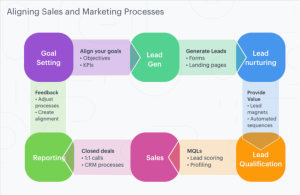
The Core Components: What Makes This Framework Work
1. Marketing-Sales SLA (Service Level Agreement)
The cornerstone of any successful sales and marketing alignment strategy is a formal SLA that clearly defines responsibilities, expectations, and commitments from both teams. This isn’t just a feel-good document—it’s a binding agreement that creates accountability.
A well-crafted marketing-sales SLA typically includes:
- Lead volume commitments: Marketing agrees to deliver a specific number of qualified leads monthly
- Lead quality definitions: Clear criteria for what constitutes a marketing-qualified lead (MQL) versus a sales-qualified lead (SQL)
- Response time requirements: Sales commits to following up with qualified leads within a defined timeframe (often 24-48 hours)
- Feedback loops: Sales agrees to provide timely feedback on lead quality and outcomes
- Mutual KPIs: Both teams share responsibility for pipeline metrics and revenue targets
This formal agreement transforms vague complaints like “marketing doesn’t send good leads” into specific, measurable discussions about whether agreed-upon criteria are being met.
2. The Smarketing Checklist
Consistency is key to scalable growth. The smarketing checklist ensures both teams follow standardized processes that prevent leads from falling through the cracks. This operational tool typically covers:
- Joint development of ideal customer profiles (ICPs)
- Agreed-upon buyer personas with detailed attributes
- Unified lead scoring criteria
- Standardized lead qualification questions
- Documented handoff procedures and communication protocols
- Regular sync meeting schedules
- Shared content libraries and sales enablement materials
By working from the same checklist, sales and marketing eliminate confusion about priorities, target customers, and messaging—creating a seamless experience from first touch to closed deal.
3. Streamlined Lead Handoff Process
One of the biggest revenue leaks in most organizations happens during the lead handoff process—that critical moment when marketing passes a qualified prospect to sales. The Smarketing Secret addresses this with structured protocols that ensure no lead gets lost or ignored.
A proper lead handoff includes:
- Automated notifications: Sales receives immediate alerts when MQLs are ready for outreach
- Complete context transfer: All relevant information about the lead’s journey, content interactions, and pain points accompanies the handoff
- Clear next steps: Specific actions sales should take with recommended messaging
- Follow-up tracking: Systems to monitor whether and when sales engages with handed-off leads
- Closed-loop reporting: Feedback from sales back to marketing about lead quality and outcomes
Platforms like Smarketing Cloud enhance this process with AI-powered features that prioritize leads, suggest optimal outreach timing, and automate workflow triggers to ensure nothing slips through the cracks.
4. Revenue Team Alignment Through Shared Goals
Traditional structures pit sales and marketing against each other with conflicting metrics—marketing chases lead volume while sales focuses on deal quality. True revenue team alignment requires both departments to share responsibility for the same ultimate goal: revenue growth.
This means:
- Both teams are measured on pipeline contribution, not just their isolated metrics
- Marketing is accountable for lead quality and conversion rates, not just lead quantity
- Sales is responsible for providing feedback that improves marketing campaign effectiveness
- Compensation and recognition systems reward collaboration rather than departmental wins
- Executive leadership treats sales and marketing as a unified revenue organization
When both teams win or lose together based on actual revenue outcomes, the incentives for collaboration become irresistible.
5. Data Transparency and Closed-Loop Reporting
Information silos kill alignment. The Smarketing Secret emphasizes complete data transparency where both teams have access to the same metrics, dashboards, and reporting systems.
Closed-loop reporting connects marketing activities directly to revenue outcomes by tracking:
- Which campaigns and content pieces generate the highest-quality leads
- Conversion rates at each funnel stage from first touch to closed deal
- Sales cycle length by lead source and campaign
- Customer acquisition cost by channel
- Revenue attribution across the entire customer journey
This visibility allows marketing to optimize campaigns based on actual sales outcomes rather than vanity metrics, while sales gains insight into which leads deserve priority attention based on engagement history.
6. AI-Powered Optimization and Automation
While the core framework is technology-agnostic, modern implementations often leverage AI capabilities to enhance alignment. Platforms like Smarketing Cloud provide:
- AI agents that optimize ad budgets across channels based on conversion data
- Predictive lead scoring that identifies which prospects are most likely to close
- Automated personalization that adapts messaging based on individual buyer behavior
- Intelligent workflow routing that ensures leads reach the right sales rep at the right time
- ROI measurement tools that track performance across the entire funnel
These AI enhancements don’t replace the strategic framework—they amplify its effectiveness by handling routine tasks and surfacing insights that humans might miss.
Pricing: What Does Implementation Cost?
Here’s where The Smarketing Secret differs from typical software reviews—since it’s a strategic framework rather than a standalone product, there’s no single price tag. Your investment depends on which supporting technologies you choose to implement the strategy.
Framework Implementation Costs
The conceptual framework itself is essentially free to implement, though you’ll invest significant time and potentially consulting resources to:
- Develop your marketing-sales SLA (typically 2-4 weeks of collaborative work)
- Create your smarketing checklist and standardized processes
- Train both teams on new protocols and shared expectations
- Establish regular sync meetings and communication rhythms
Supporting Platform Costs
Most organizations implement this framework using existing or new marketing technology platforms:
Smarketing Cloud: This platform specifically designed around smarketing principles serves over 6,000 customers but doesn’t publish standard pricing tiers. You’ll need to contact them directly for customized quotes based on your company size, user count, and feature requirements.
HubSpot Sales and Marketing Hub: A popular choice for implementing smarketing strategies, HubSpot offers integrated sales and marketing tools starting around $800-$1,000+ monthly for professional tiers with closed-loop reporting and SLA capabilities.
Salesforce Marketing Cloud: Enterprise-scale solution with pricing typically starting at several thousand dollars monthly, offering advanced AI features through Einstein (the primary AI engine) and their new, fully autonomous Agentforce AI capabilities. Comprehensive data integration through Data Cloud.
Alternative Solutions: Tools like Salesloft, LeadFuze, and Dynamics 365 offer various capabilities supporting smarketing implementation, often with free trials and tiered pricing based on features and users.
The sweet spot for most mid-market B2B companies implementing a comprehensive sales and marketing alignment strategy falls between $1,000-$5,000 monthly for the technology stack, plus internal resource allocation for process development and ongoing management.
Pros and Cons: The Real-World Impact
Advantages of the Smarketing Secret Approach
Dramatically Shorter Sales Cycles: When marketing properly qualifies leads and provides complete context during handoff, sales spends less time on discovery and more time closing. Companies implementing these principles report sales cycle reductions of 20-40%.
Reduced Customer Acquisition Costs: Efficient lead filtering and better targeting mean both teams spend resources only on prospects likely to convert. This efficiency typically drives down overall CAC by eliminating wasted effort on poor-fit leads.
Improved Lead Quality: With clear SLA definitions and feedback loops, marketing continuously refines targeting and qualification criteria based on which leads actually close. This virtuous cycle progressively improves lead quality over time.
Enhanced Customer Experience: When sales and marketing share data and coordinate messaging, prospects receive consistent, relevant communications throughout their journey rather than disjointed experiences that undermine trust.
Increased Revenue Per Customer: Alignment enables better identification of expansion and upsell opportunities since both teams track the complete customer lifecycle rather than focusing only on their isolated stages.
Data-Driven Decision Making: Closed-loop reporting and shared dashboards replace gut feelings and interdepartmental blame with objective data about what’s working and what needs adjustment.
Cultural Transformation: Beyond tactical benefits, successful implementation creates a collaborative culture where teams solve problems together rather than defending territorial boundaries.
Challenges and Limitations
Requires Organizational Change Management: The biggest barrier isn’t technical—it’s human. Implementing true revenue team alignment requires overcoming entrenched departmental cultures, which can face significant resistance from team members comfortable with the status quo.
Demands Executive Sponsorship: Without strong leadership commitment from the C-suite, sales and marketing alignment initiatives often stall when departments revert to old habits during challenging periods.
Technology Integration Complexity: While the framework is technology-agnostic, practical implementation requires integrating CRM, marketing automation, and analytics platforms. This technical work can be complex and time-consuming, particularly in organizations with legacy systems.
Time Investment Before ROI: Developing effective SLAs, checklists, and new processes takes time. Organizations should expect 3-6 months of implementation work before seeing significant results, which can test patience and commitment.
Ongoing Maintenance Required: This isn’t a “set it and forget it” solution. Effective smarketing requires regular review of SLAs, continuous process optimization, and sustained attention to maintain alignment as teams and markets evolve.
Potential Over-Reliance on Technology: Some organizations make the mistake of thinking new software alone will solve alignment problems. The framework’s effectiveness depends on strategic implementation, not just tool deployment.
How The Smarketing Secret Compares to Alternatives
Smarketing Cloud
As a platform specifically built around smarketing principles, Smarketing Cloud directly enables the framework with unified CRM and marketing capabilities, AI-powered automation, and comprehensive cross-channel campaign management (email, social, chat, video).
Best for: Organizations wanting an all-in-one solution designed specifically for sales and marketing alignment rather than adapting general-purpose tools.
Key differentiation: Purpose-built for the smarketing framework with AI agents that optimize budgets, personalize experiences, and automate lifecycle management from lead generation through conversion.
Salesforce Marketing Cloud
This enterprise-grade platform excels at revenue team alignment through sophisticated features like Agentforce AI for autonomous campaign building, real-time audience segmentation via Data Cloud, and extensive personalization capabilities.
Best for: Large enterprises with complex, multi-brand marketing operations requiring maximum customization and scale.
Key differentiation: Superior data integration and real-time processing capabilities, but comes with higher complexity and cost compared to the straightforward smarketing framework approach.
HubSpot Sales and Marketing Hub
HubSpot’s integrated approach makes it particularly strong for implementing marketing-sales SLAs and smarketing checklists with built-in closed-loop reporting and shared data access.
Best for: Small to mid-market B2B companies seeking ease of use and quick time-to-value without enterprise complexity.
Key differentiation: Lower learning curve and better suited for SMBs than Salesforce, with strong native integration between sales and marketing tools, though less AI sophistication than Smarketing Cloud.
Salesloft, LeadFuze, and Dynamics 365
These platforms focus primarily on specific aspects of the sales process—outreach automation, lead generation, or CRM management—and can complement the smarketing framework but don’t provide comprehensive unified solutions.
Best for: Organizations with established marketing automation who need to strengthen specific sales capabilities or those already committed to the Microsoft ecosystem (Dynamics 365).
Key differentiation: Specialized depth in particular areas like sales engagement (Salesloft) or prospecting (LeadFuze), but require integration with separate marketing platforms to achieve full smarketing alignment.
Freshworks CRM
Freshworks emphasizes smarketing integration for customer acquisition and revenue growth with good efficiency but less AI sophistication than specialized platforms.
Best for: Budget-conscious growing companies seeking solid fundamentals without cutting-edge AI features.
Key differentiation: Competitive pricing with decent smarketing capabilities, though less advanced automation than premium alternatives.
Who Should Implement The Smarketing Secret?
Ideal Candidates for This Framework
B2B Companies with Complex Sales Cycles: Organizations where leads require multiple touchpoints and nurturing before conversion benefit enormously from coordinated sales and marketing efforts throughout extended buying journeys.
SaaS and Technology Companies: Fast-growing tech businesses with product-led growth models need tight alignment to efficiently move prospects from freemium to paid, and from small plans to enterprise agreements.
Organizations Experiencing Lead Leakage: If your analytics show significant drop-off rates during the MQL-to-SQL transition, or if sales regularly complains about lead quality, you’re an ideal candidate for implementing this lead handoff process framework.
Companies with Misaligned Metrics: When marketing celebrates hitting lead volume targets while sales simultaneously misses quota, you have a classic alignment problem this framework addresses.
Businesses Scaling Revenue Teams: As companies grow from founder-led sales to structured revenue organizations, implementing these principles early prevents the dysfunctional silos that plague larger enterprises.
Marketing Leaders Seeking Greater Impact: CMOs who want to demonstrate clear ROI and revenue contribution rather than just activity metrics will find this framework provides the structure and visibility needed to prove marketing’s business impact.
Sales Leaders Frustrated with Lead Quality: VPs of Sales tired of their reps wasting time on unqualified prospects can use the marketing-sales SLA to establish clear expectations and accountability.
Who Might Look Elsewhere
Very Early-Stage Startups: Companies with fewer than 10 employees doing founder-led sales may not yet need formal smarketing structures—though learning these principles early prevents future problems.
Pure B2C E-commerce: Businesses with transactional, single-touch sales and automated checkout processes have less need for sales-marketing coordination than complex B2B environments.
Organizations Unwilling to Change: If leadership isn’t committed to breaking down departmental silos, implementing this framework will frustrate everyone involved. Cultural readiness is essential.
Integration Capabilities: Building Your Smarketing Stack
The framework’s flexibility allows integration with virtually any modern marketing and sales technology stack. Here’s how different platforms support implementation:
Unified Platforms
Smarketing Cloud provides native unification of CRM, sales tools, and marketing capabilities in a single platform supporting web, social, mobile, email, chat, and video channels. This all-in-one approach minimizes integration complexity.
Best-of-Breed Integrations
Most organizations implement the framework across multiple specialized tools:
- CRM Systems: Salesforce, HubSpot CRM, Microsoft Dynamics, or Pipedrive serve as the system of record for customer data and sales activities
- Marketing Automation: HubSpot Marketing Hub, Marketo, Pardot, or ActiveCampaign handle campaign execution and lead nurturing
- Analytics and Reporting: Tools like Tableau, Looker, or native platform dashboards provide the closed-loop reporting essential for transparency
- Communication Tools: Slack, Microsoft Teams, or dedicated revenue operations platforms facilitate the regular sync meetings and real-time coordination the